



Website language
English
Rugby aims to reach new heights in Bolivia
Plans are afoot to play a game of rugby at 6,500 metres above sea level in Bolivia, which could help raise the sport's profile there.
By Frankie Deges
The goal is to have a game of rugby played at 6,500 metres above sea level by March of next year. This would not only be a unique sporting event and the highest any ball-sport has ever been played competitively – together with a football game played in 2001 – but also an opportunity for specific scientific research.
“The plan is to use this tournament as a way to investigate how the body reacts at this altitude,” explained Loïc Devaux, from the La Paz Rugby Club. Planned for March 2015 at the Cerro Sajama, a flat volcano in western Bolivia, “it will also showcase rugby and show that as a sport we can go places in this country.”
Altitude can play tricks with the body, even for players in La Paz who are used to playing at 3,500 metres. “I am well accustomed to playing here but whenever we play in Santa Cruz de la Sierra, at only 400 metres above sea level, I struggle with heat and humidity,” said Devaux, explaining the challenges of playing in the city he first came to in 2003 and married Silvia Sánchez Chumacero, one of the local girls who have embraced the game. He is fully committed to developing the sport he learnt at home, in France.
As a new sport in a country with no oval ball culture, it has been difficult to get financial and governmental assistance, although it is through the Bolivian Olympic Committee that doors are starting to open. Elmer Banegas, President of the Federación Boliviana de Rugby (FBR), came across the game aged 30 and was soon in love. At 38, he is finding the going tough in search of official backing.
Opening doors
“With rugby now in the Olympics it seems to be easier to get formal recognition and with it doors will open; financially we need to be able to support the game’s development,” he explained.
Long-term plans are conditional to being recognised as a national federation. Under Bolivian sporting laws, rugby would need a big growth around the country, which might take longer than hoped for, thus the Olympic road. With the game in its 10th year of consecutive activity, Banegas admits that “amateur efforts have reached a point where funding and assistance is required. We need to show a sport that is growing and developing.”
Furthermore, new generations will also allow those who are currently playing, coaching, refereeing and running the game be able to share the workload with more people. “Bolivian rugby is lacking qualified coaches and referees. It is all part of a process which we are undertaking.”
When the FBR is given some form of support from the country’s Olympic body – which could be in the very near future – then the International Rugby Board’s Regional Association in South America – CONSUR (Confederación Sudamericana de Rugby) – will be in a position to come in and assist.
Huge commitment to play
“We are closely monitoring developments in Bolivia and are in touch with officials there,” explained Santiago Ramallo, IRB Regional Development Manager for South America. “Our hopes are that within the next few months, they can get some form or formal recognition and we can take Get Into Rugby and other development programmes to them and help their growth.”
Bolivia is a landlocked country in western-central South America. While almost 60 per cent of its land is below 450 metres above sea level, it is the Andean region that is located well above 3,000 metres. Five of the nine departments that make up the country play the game and only Santa Cruz de la Sierra is at 416 metres. There are more clubs at altitude: La Paz (3,650m), Tarija (1,875m), Oruro (3,735m) and Cochabamba (2,570m) have rugby teams, yet competition is not ideal as travel is very difficult in a mountainous terrain.
Distances are a huge problem in Bolivia: to drive, say, from La Paz to Tarija takes 24 hours. Santa Cruz is the country’s rugby hot-bed with four teams that play regularly against each other; yet it can take up to 16 hours to drive up to La Paz, so rugby-playing cities are often disconnected from each other. Love of the game is such that players will travel at their own expense. As Devaux put it, “because of their commitment, they are heroes to me.” Growth will generate more funding and competition will grow.
Devaux, a web-page programmer, has done marvels with promotion in La Paz. Rugby is developing in El Alto, a La Paz neighbourhood at 4,062 metres, where the highest game of rugby ever was played in 2013. “Social media is helping us. We recently had a tournament called 3600, because of the altitude it is played at and we made it to the front page of a couple of newspapers and we had television coverage.”
Building for the future
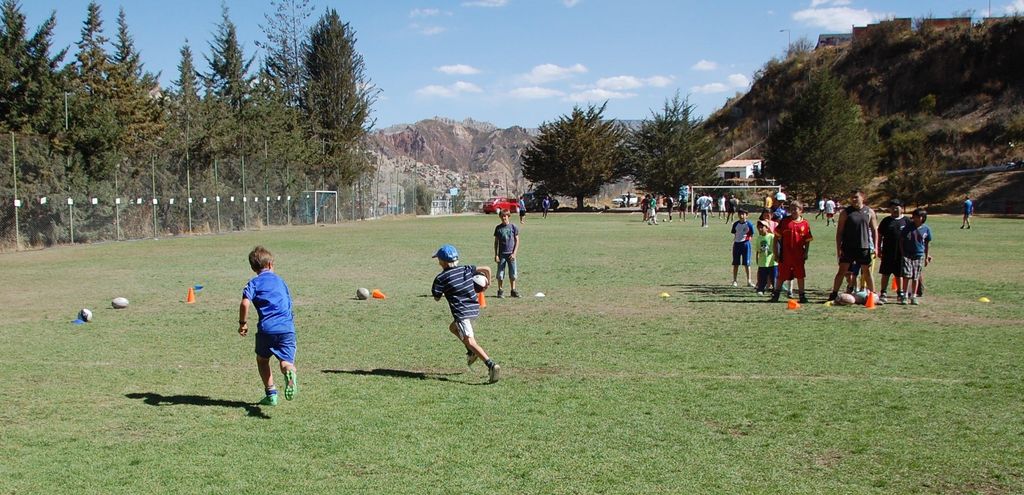
All these efforts are paying off; when the game started it had an ex-pat base, but now it is mostly Bolivians that play rugby. In La Paz, children started playing a month ago and soon the numbers jumped to 20, with schools becoming interested in having the game in their curriculum. It is an open game, with different social classes involved.
When multi-sports regional event, the Odesur Games comes to Cochabamba in 2018, the hope is that rugby will have by then been officially recognised and national teams will be competing regionally.
“We are getting invitations from our neighbours in Peru, Brazil, Chile and Argentina and some teams from those countries come and play against us,” said Banegas.
There were two earlier attempts to launch the game, but this third, sustained over a decade, with the formation of clubs, a more formal approach and 90 per cent of the players born in the country bodes well for the future.
This feature forms part of our Around The Regions series exploring the game beyond its traditional heartlands. Do you have an interesting story to tell about rugby around the world? Let us know by emailing aroundtheregions@irb.com.
Last updated: Oct 1, 2014, 12:28:02 PM
Download all rugby fixtures to your calendar
Get every fixture delivered to your calendar by subscribing to World Rugby's calendar to sync all matches to your device
Add fixtures to calendar ↗
