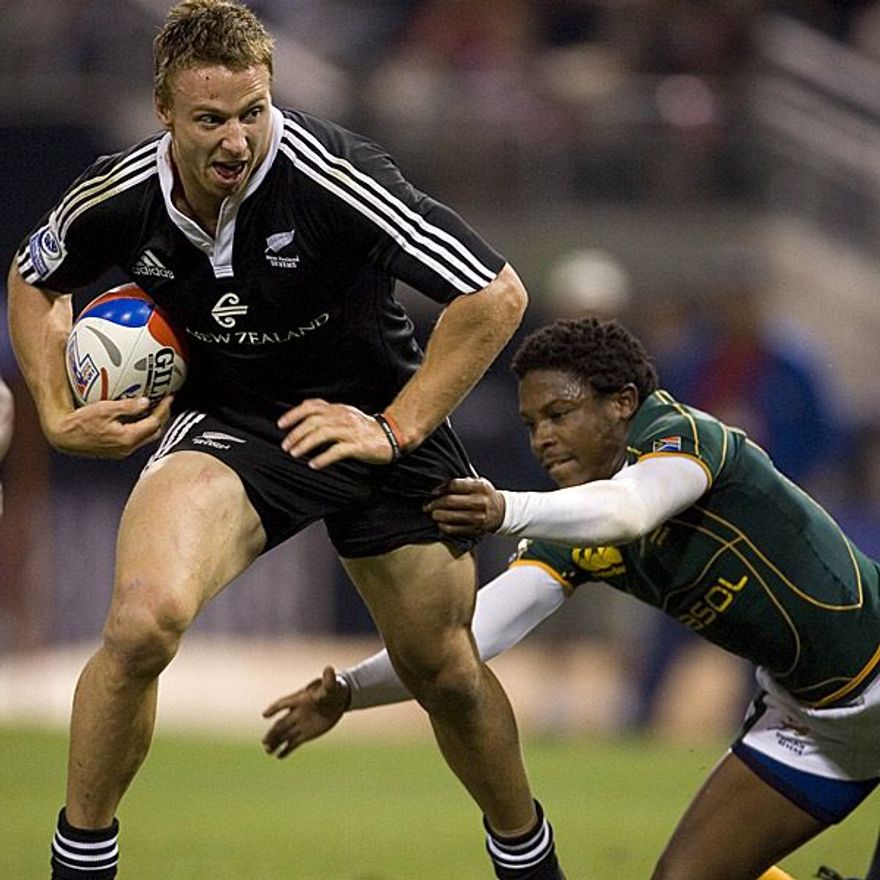




Seven-a-side rugby is 125 years old this season. It was born in 1883 – 10 years after the formation of the Scottish Football Union – in Melrose, a prosperous little town in the South of Scotland, an area known as the Scottish Borders.
The Melrose club had a fine rugby side in which the star players were the local butcher David Sanderson and his apprentice Ned Haig. However, the new club was experiencing serious financial difficulties and the committee, in an attempt to raise the much-needed finance, decided to organise an athletic meeting, or a Sports Day, at the end of the 1883 season.
“Want of money made us rack our brains as to what was to be done to keep the club from going to the wall, and the idea struck me that a football tournament might prove attractive,” recalled Haig.
The committee felt that given the numbers involved the proposal was unworkable. According to the Melrose club historian Les Allan, Sanderson reminded his apprentice and team-mate of having played in some sort of reduced numbers tournament while working on the English side of the border.
The solution became obvious, to cut down the size of the team from 15 to seven players (three forwards, two half backs and two backs) and the playing time to 15 minutes in total (two halves of seven minutes each and one minute half-time break). The Melrose committee agreed unanimously to hold a Sevens tournament, unaware of the historic significance of their decision.
Seven Border clubs – Gala, Selkirk, St. Cuthbert’s Hawick, Earlston, Melrose, Gala Forest and St. Ronan’s Innerleithen – entered the first tournament held on 28 April 1883 at the now famous Greenyards ground with the picturesque Eldon Hills in the background. The Sports Day programme of events included foot races, dribbling race, drop goal and place kicking competitions. However the main attraction was the Sevens tournament.
The Border Advertiser of 2 May 1883 wrote: “The competition has been looked forward to with great interest, as most clubs of the district were expected to compete for the prize – a silver cup presented by the Ladies of Melrose.”
Sudden death in first final
Not surprisingly the leading clubs in the district – Gala and Melrose – reached the final. The match between the two fierce rivals, which ended in a draw after 15 minutes of play, had an unexpected outcome that originated the sudden-death feature of the modern Sevens game.
“After playing the statutory 15 minutes they decided to play extra-time. Sanderson scored a cheeky blind-side try and, being captain, led his team from the field and claimed the Ladies Cup. Gala protested, but in vain,” explained Melrose Sevens historian Les Allan.
The Melrose players, who had broken away from the Gala club some six years previously, turned a deaf ear to the protestations of their opponents. The sudden-death rule stood the test of time to become a feature of today’s Sevens game when the teams are level at the end of a match.
Sanderson, who for an unknown reason had a major disagreement with the Melrose Committee, walked home with the Ladies Cup, which re-emerged in the Melrose Club museum, donated by a relative, after more than a century. From 1884 onwards, the tournament trophy was the second Ladies Cup, which has now joined the original one in the Melrose club collection.
Sevens popularity grows
Sevens spread quickly in the Scottish Borders with Selkirk, Gala, Hawick, Jedforest, Langholm, Kelso and Earlston following in the footsteps of Melrose and launching their own club tournaments. Since the 1885 Cup, Sevens rugby has become a major feature both at the beginning and the end of the season in the Scottish Borders.
It is said that Nelson, the cradle of the New Zealand game, were the first to hold a School Sevens tournament outside Scotland around the turn of the century, but the documentary evidence is scant. Instead, there is plenty of evidence that 1921 was the year Sevens rugby took off internationally with the North Shields Sevens at Percy Park in England and the Buenos Aires Sevens sharing the distinction of being pioneers of the international short game.
The Middlesex Sevens, launched by Dr Cargill, a Scottish member of the County Committee in 1926, became an attractive end-of-season event in England, but the biggest seven-a-side tournament in the world remains Rosslyn Park Sevens, launched in 1939 by the late Charles Burton, the founder of the Public School Wanderers, which gathers every year more than 300 school teams and over 3,500 schoolchildren from all over the world.
Nowadays there is hardly a rugby territory in the world without its own Sevens tournament and for a nearly a century Sevens rugby remained a wonderful pastime, played by clubs and teams to wind up a long and demanding season or as a gentle build-up to the new one.
This went on until 1973, when the Scottish Rugby Union decided to celebrate its centenary in style with an international seven-a-side tournament, the first in history. The SRU Centenary Sevens gave a glimpse of the huge potential of the short game. Somewhat prophetically, it was England who prevailed in the end to beat an exciting Irish team in the final at Murrayfield, having overcome in the process strong opposition from a star-studded Welsh side, the Scots, New Zealand, Australia, France and the Barbarians.
Hong Kong seed sown
Legend has it that among the keen Murrayfield crowd in May 1973, there were a couple of expatriates, one Ian Gow, an executive with Rothman’s Tobacco Company in Hong Kong, and ‘Tokkie’ Smith, the then Chairman of the Hong Kong RFU, who were impressed by the novelty and the thrill of the short game in its maiden international competition.
Between the two the idea of a regular Sevens tournament took shape and by the end of 1975, with Jock Campbell, the then Promotions Manager of the Cathay Pacific Airline joining the team, the first Hong Kong Sevens tournament was on the drawing board.
The Hong Kong International Sevens started the following year in 1976, and after several lean years – when it battled to make ends meet – it finally became the star of international Sevens in the mid 1980s. The tournament went from strength to strength and its public and commercial success, congenial atmosphere and outstanding rugby, did wonders to promote the idea of a world tournament, which materialised some 10 years later in 1987.
First RWC Sevens
Twenty years after the SRU Centenary Sevens tournament and following the successful completion of two Rugby World Cups in 1987 and 1991, the game of Sevens was ready to take the international plunge. The International Rugby Board accepted the SRU proposal to hold a RWC Sevens Tournament in 1993 with the offer of the Melrose Cup, a trophy modelled on the original Ladies Cup of Melrose, as the top prize.
The RWC Sevens, as it approaches its fifth edition in Dubai next March, has gone from strength to strength and Sevens is now a core game at many multi-sport international competitions including the Asian Games and Commonwealth Games.
The launch of the IRB Sevens World Series at the end of 1999 has provided the framework for the growth of Sevens from a village pastime into a worldwide Grand Prix circuit, followed by large crowds and afforded unparalleled television coverage. During the last decade, Rugby Sevens, a village game born in Melrose 125 years ago, has taken the world by storm.