



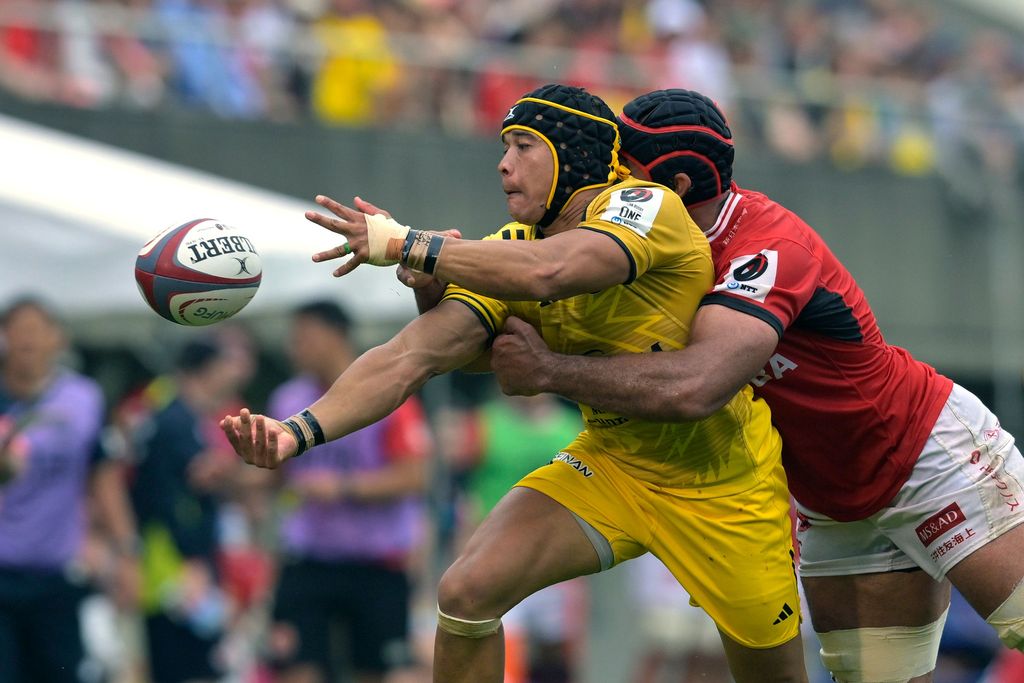
The fifth season of NTT Japan Rugby League One came to a close on 7 June with a crowd of 50,451 at Tokyo’s MUFG Stadium, as Kobe Steelers defeated Spears Tokyo-Bay 22-13 to claim their first League One title. It was the club’s third national championship overall, following titles in the former Japan Rugby Top League in 2003 and 2018.
Head coach Dave Rennie completed his third season in charge. With his departure already confirmed as he prepares to take up a role with the All Blacks, Rennie signed off in style alongside captain Brodie Retallick. Key performers Ardie Savea and Anton Lienert-Brown will also leave the club after the season as they pursue opportunities to return to the All Blacks setup.
Retallick finished the season as League One’s leading try-scorer with 17 tries and was named the competition’s MVP at the awards ceremony the following day.
At 35 years old, he continues to demonstrate why he remains one of the world’s premier second-rows.One of the most interesting moments of the post-final press conference came when Rennie was asked whether he would consider selecting Retallick for the national team. “I’d love to take him home with me,” he replied immediately.
Retallick added: “It’s always an honour to represent your country, but I understood and accepted New Zealand’s eligibility rules when I decided to play in Japan. Of course, I would like to play international rugby again, but that would only be possible if those rules changed.”
Anyone who watched his performances throughout the season would struggle to argue that he is no longer capable of wearing the black jersey.
Savea, meanwhile, said: “I’ll spend the next six weeks resting and being with my family. After that, if I’m called into a national team camp, I’ll give everything I have.”
The Steelers’ previous title came under Wayne Smith, with Andy Ellis and Dan Carter directing the team as the half-back duo. The attacking style traditionally associated with New Zealand rugby appears to fit naturally within Kobe’s internationally influenced sporting culture.
Spears finished third during the regular season and entered the final having played three consecutive weeks of knockout rugby, one match more than Kobe. Their forwards delivered another committed performance and helped produce a high-quality final. The absence of influential hooker Malcolm Marx, who injured his shoulder in the semi-final, was significant.
However, full-back Shaun Stevenson continued to enhance his reputation during his second season with the club.
Having been limited last season due to contractual commitments with the Chiefs, Stevenson enjoyed a full League One campaign in 2025-26. He had openly stated that his goal was to help the club reach the play-offs, and his performances reflected that ambition. Spears’ only try in the final stemmed from an attacking opportunity created by one of Stevenson’s trademark 50:22 kicks.
Stevenson earned one All Blacks cap earlier in his career and is now also eligible to represent Samoa. Although he will remain with Tokyo-Bay next season, he has expressed a desire to play international rugby for Samoa, making him a strong candidate to wear the blue jersey at next year’s Rugby World Cup.
South Africa wing Cheslin Kolbe, who spent three seasons with Tokyo Sungoliath and became one of the competition’s most recognisable players, had initially been linked with another season in Japan. However, following his side’s semi-final defeat, it was confirmed that he will join the Stormers.
Defending champions Brave Lupus Tokyo endured a difficult campaign, finishing sixth after suffering a seven-match losing streak in the middle of the season. The club won the title in Richie Mo’unga’s first year in Japan, but injuries and departures affected their ability to defend the crown. Former Brave Lupus hooker Mamoru Harada is now with Moana Pasifika, while former team-mate Warner Dearns, widely expected to captain Japan at next year’s Rugby World Cup, is playing for the Hurricanes.
New Zealand international Shannon Frizell, a key figure in the club’s back-to-back championships, was limited to just two appearances because of injury. Both Frizell and Mo’unga will leave Japan after this season and have publicly stated their ambitions to re-enter All Blacks selection discussions.
Another major departure is South Africa scrum-half Faf de Klerk, whose arrival at Yokohama Eagles helped attract significant attention and support for the club. After playing in Japan since the 2022-23 season, he will return to South Africa with the Cheetahs. Springbok centre Jesse Kriel, who captained the Eagles this season, is set to remain with the club.
One notable trend in recent seasons has been the growing number of teams led by high-profile international stars. Retallick captained Kobe Steelers, Sam Cane led Sungoliath, TJ Perenara captained Black Rams Tokyo, and Kwagga Smith captained Shizuoka Blue Revs.
Heat enjoyed their best-ever finish in ninth place. Argentina flanker Pablo Matera captained the side until last season, while Fiji hooker Tevita Ikanivere made an immediate impact after arriving this year. His 10 tries matched Kolbe’s total, and both players are expected to feature prominently at next year’s Rugby World Cup.
International talent can also be found in Division Two. Australia fly-half Noah Lolesio played a key role in Shuttles Aichi’s championship-winning campaign and will remain with the club despite the team's failure to secure promotion. Hanazono Liners, who finished third, added South Africa fly-half Manie Libbok, who worked under former Wallabies halfbacks Will Genia and Quade Cooper in the coaching group.
With Rugby World Cup 2027 now just over a year away, more international players are choosing Japan as a destination. Japan internationals such as Warner Dearns and scrum-half Naoto Saito are returning to domestic rugby, with Saito having recently played for Toulouse in France’s Top 14. Combined with another wave of global stars arriving in the competition, Japan Rugby League One’s profile continues to grow both at home and abroad.
