Five more rugby greats complete prestigious World Rugby Hall of Fame class of 2026
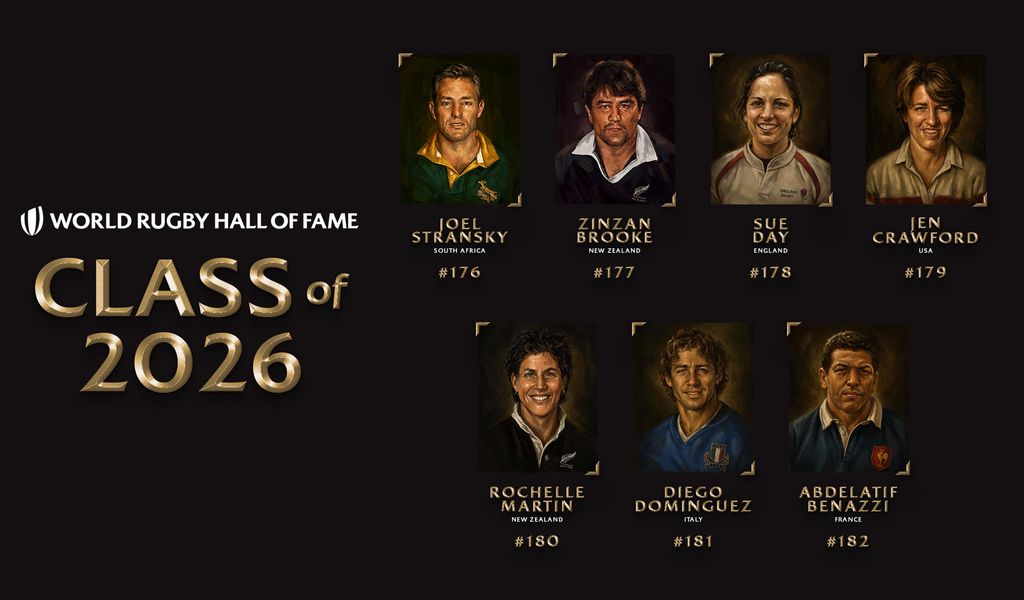
World Rugby has announced the remaining five modern greats that will join Joel Stransky and Zinzan Brooke in being inducted into the World Rugby Hall of Fame over the coming months as the class of 2026.
Abdelatif Benazzi (France), Jen Crawford (USA), Sue Day (England), Diego Dominguez (Italy) and Rochelle Martin (New Zealand) will take the number of inductees to 182 since the Hall of Fame began in 2006.
Joel Stransky (South Africa) and Zinzan Brooke (New Zealand) were the first of the class of 2026 to be inducted into the Hall of Fame during a special ceremony in Cape Town on 27 August, two days before the second test of the Rugby’s Greatest Rivalry series between their two nations.
Jen Crawford was a central figure in USA winning the inaugural Women’s Rugby World Cup in 1991, beating England 19-6 in the final. She will be inducted alongside Sue Day, twice a runner-up in the showpiece event with the Red Roses and still their record try-scorer, at the WXV Global Series 2026 match between USA and England in New Jersey on 30 October.
A day later, at One New Zealand Stadium in Christchurch, three-time Women’s Rugby World Cup winner Rochelle Martin will be inducted into the Hall of Fame as the Black Ferns face France in another WXV Global Series encounter.
Abdelatif Benazzi, the Morocco-born veteran of 78 caps in the back row for France from 1990-2001 who is now vice-president of the Fédération Française de Rugby and a World Rugby Council member, will be the sixth in the class of 2026 to be inducted, at the World Rugby Council dinner in Dublin on 17 November.
That leaves Dominguez, the former Argentina and Italy fly-half who played in three Rugby World Cups and was a talisman as the Azzurri transitioned into the Men’s Six Nations in 2000. He will be inducted ahead of one of Italy Men’s Six Nations matches versus either France or Wales in Rome in March.
The World Rugby Hall of Fame recognises those that have made an outstanding contribution to the game of rugby throughout their careers, while also demonstrating rugby’s character-building values of integrity, passion, solidarity, discipline and respect.
World Rugby Chair Brett Robinson said: “On behalf of the global rugby family, I would like to congratulate Jen, Sue, Rochelle, Diego and Abdel on their richly deserved inductions into the World Rugby Hall of Fame, joining Joel and Zinzan in taking our class of 2026 to seven members.
“They have each made their mark on our sport, not only on the pitch but also off it. Jen was a trailblazer for women’s rugby in the USA, Sue is still the Red Roses’ record try-scorer and Rochelle won three Women’s Rugby World Cups.
“I actually made my test debut for Australia against an Italy side featuring Diego, who would go on to become a talisman for the Azzurri. Abdel continues to be a driving force within the game, just as he was on the field, as a World Rugby Council member and steadfast chair of the men’s High-Performance Committee.”
John Eales, Chair of the Hall of Fame panel and a Hall of Fame inductee, said: “This year’s inductees represent the very best of our sport with extraordinary talent matched by humility, leadership and an unwavering commitment to rugby’s values. From World Cup-winning moments etched in history to the quiet, tireless work many have done to grow and champion the game long after their playing days, each of them has shaped rugby for the better. On behalf of the Hall of Fame, I warmly welcome them into the fold.”
For more information on the World Rugby Hall of Fame, visit www.world.rugby/halloffame.
World Rugby Hall of Fame 2026 inductees
No.176 – Joel Stransky (South Africa)
No.177 – Zinzan Brooke (New Zealand)
No.178 – Sue Day (England)
No.179 – Jen Crawford (USA)
No.180 – Rochelle Martin (New Zealand)
No.181 – Diego Dominguez (Italy)
No.182 – Abdelatif Benazzi (France)
Sue Day (England)
World Rugby Hall of Fame – Inductee No.178
Like many of the best female players of her generation, Sue Day excelled in a multitude of positions. During her 59-test England career, she played at centre, wing and full-back, seamlessly slotting into the different positions as and when required.
Despite her test career finishing nearly two decades ago in 2007, Day still holds England women’s all-time try-scoring record, crossing for a remarkable 61 tries in a decade of service to the Red Roses between 1997 and 2007.
Helped by her outstanding footwork, Day scored 19 tries across three Women’s Rugby World Cups (1998, 2002 and 2006), a tally only bettered by Black Ferns ace Portia Woodman-Wickliffe. Five of those tries were scored in a single match against Italy in 2002, while she also bagged four tries on two occasions, against Canada in 1998 and South Africa in 2006. Day also represented England at the inaugural Women’s Rugby World Cup Sevens in 2009, captaining the side at the tournament.
While Day had to be content with two Women’s Rugby World Cup runners-up medals, she was one of the driving forces behind three Women’s Six Nations Grand Slam campaigns, captaining the team in the last of the triumphs in 2007.
After hanging up her boots, she commentated on women’s rugby for Sky Sports and World Rugby, became Wasps FC’s first-ever female President, having previously served the club as a player for 15 years, and a partner in Corporate Finance at her accountancy firm.
In another first, Day was appointed as the RFU’s Chief Operating Officer and Chief Financial Officer in 2017. The role included being Executive lead for the women’s game where she played a lead role in driving the women’s game forward. That included leading on the business case for women’s rugby in England to drive the growth in the game, the creation of the PWR as a standalone, independent league and leading the bid for Women’s Rugby World Cup 2025. She stayed there until late 2024, when she became director of Women’s Football at The Football Association.
A founding trustee of the Women’s Sports Trust, Day was awarded an MBE in 2020 for services to gender equality in sport.
Jen Crawford (USA)
World Rugby Hall of Fame – Inductee No.179
Jennifer Crawford is regarded as one of the finest female rugby players North America has ever produced. A supremely versatile and dangerous attacking player, she excelled at fly-half, centre and full-back during a distinguished international career with the USA.
A potent attacking threat, Crawford scored 24 test tries in 23 caps for the Women’s Eagles over a 12-year period from 1988-2000, including a try on her Women’s Rugby World Cup debut against the USSR in 1991. At the time of her retirement, she was the all-time leading Women’s Eagles try-scorer.
The Stanford University graduate was a central figure in the USA team that won the inaugural Women’s Rugby World Cup in Cardiff, 19-6 against England. She subsequently appeared in the next two finals in 1994 and 1998, both of which ended in defeat.
She scored twice as the Women’s Eagles lost 38-23 to England in 1994 before captaining them to a second consecutive runners-up finish four years later in Amsterdam, losing 44-12 to New Zealand.
Crawford’s legacy extends well beyond her international statistics. During her time as a player and later as a coach, she was a passionate champion of women’s rugby at every level, helping to create pathways for the next generation of female players.
With the Berkeley All-Blues, she helped lead the club to nine consecutive USA Rugby National Women’s Club Championships, playing and coaching alongside fellow World Rugby inductee Kathy Flores.
She co-founded the Piedmont High School Girls’ Rugby Club, creating an opportunity for young women to discover the sport she had helped elevate. The programme went on to produce six collegiate players, two college club founders and, ultimately, a USA national team player. She also served a two-year term as a Player’s Representative on the USA Rugby Board and was inducted into the USA Rugby Hall of Fame in 2019.
Rochelle Martin (New Zealand)
World Rugby Hall of Fame – Inductee No.180
Introduced to rugby at Wellington Football Club in Wellington, Rochelle Martin became one of the toughest and most talented loose forwards in her country’s history.
A professional in every sense of the word, except that she was never paid, Martin was relentless in defence and attack and had the mindset of a winner.
She was a member of the all-conquering Black Ferns team that won three successive Women’s Rugby World Cups (1998, 2002 and 2006), serving as vice-captain to Farah Palmer in the latter tournament, which brought the curtain down on her test career after 12 years at the top.
Named Black Ferns Player of the Year in only her second year in test rugby in 1995, Martin was only on the losing side once in 32 caps for New Zealand, scoring 14 tries.
Whichever team she played for tended to come out on top. Martin was unbeaten in provincial rugby with Auckland Storm, and she was also a talisman for the dominant College Rifles Club that won five Auckland club championships.
For the past 25 years, Martin has been a firefighter, rising through the ranks to now be the District Commander of Waitematā District in Auckland. She was made a Member of the New Zealand Order of Merit in 2018 for services to rugby and Fire and Emergency New Zealand, and she is also a mum of four.
Diego Dominguez (Italy)
World Rugby Hall of Fame inductee No. 181
Diego Dominguez started his career with his hometown club La Tablada in Córdoba and went on to play a significant role in the development of Italian rugby during one of the most important periods in its history.
His international career began with Argentina, earning two test caps against Chile and Paraguay in 1989. Through his mother’s Italian heritage, he qualified to represent Italy, making his Azzurri debut against France in 1991. Over the next 12 years, the fly-half earned 74 test caps.
Dominguez represented Italy at three Rugby World Cups – 1991, 1995 and 1999 – and was an important figure in the team’s successful transition into the Men’s Six Nations in 2000. In Italy’s first-ever Men’s Six Nations match, a memorable victory over Scotland, he scored 29 of the Azzurri’s 34 points, including three trademark drop goals.
When he retired from international rugby in 2003, he had scored 1,010 test points – 983 for Italy and 27 for Argentina – placing him among the select group of players to have scored more than 1,000 international points.
His achievements extended to the club game, winning four ‘Scudetto’ and one Italian Cup with Milan Rugby and helping Stade Français win four French Championship titles and one Ives du Manoir Cup. Dominguez also scored a record 30 points in the 2001 Heineken Cup final against Leicester.
Throughout his career, Dominguez was recognised for his consistency, composure and professionalism. Since retiring from playing, he has remained involved in rugby, working with developing young players and supporting programmes for disadvantaged youngsters in juvenile detention centres, continuing to promote the values of the game beyond the field.
Abdelatif Benazzi (France)
World Rugby Hall of Fame – Inductee No.182
Told as a youngster new to the sport to just pick up the ball and run forward, Abdelatif Benazzi quickly realised that rugby was his game. Aged 18, Benazzi’s performances for the Moroccan junior team on a tour of Europe caught the eye of clubs in France, and in 1988 he joined second division Cahors.
Known for his thunderous runs, Benazzi then moved to SU Agen and spent the majority of his career there, gaining legendary status over 12 years, before signing off in England as a member of a star-studded Saracens side for two seasons.
Having not long appeared for the senior Moroccan team for the first time, Benazzi became a dual international when he made his debut for France against Australia in 1990. A red card for stamping was hardly the start to his test career that Benazzi would have envisaged, but the ‘Oujda Bull’ put that setback behind him to become a figurehead for the formidable French pack.
Capable of playing second-row, flanker or number eight, Benazzi gained a reputation for his ball-handling skills as well as his physicality, and in 1994, he played a part in the ‘try from the end of the world’, scored by Jean-Luc Sadourny, which beat the All Blacks at their Eden Park fortress.
In total, Benazzi won 78 caps for his adopted country from 1990-2001, scoring 12 tries and captaining Les Bleus on 15 occasions, including leading them to the 1997 Six Nations Grand Slam. He played nine Five and Six Nations tournaments and three Rugby World Cups (1991, 1995 and 1999, the latter after battling back from a serious knee injury) and was named in the RWC 1999 Greatest XV, the year France reached their second final.
Benazzi holds the rank of Knight of Legion of Honour and Commander of the National Order of Merit. He has been vice-president of the Fédération Française de Rugby (FFR) in charge of international relations and a World Rugby Council member since 2023, and chaired World Rugby’s Men’s High-Performance Rugby Committee at the time of his induction.
Joel Stransky (South Africa)
World Rugby Hall of Fame – Inductee No.176
Joel Stransky will forever be remembered as the player who kicked South Africa to their first-ever Rugby World Cup against New Zealand in 1995.
By then, Stransky was an established international, with the fabled final falling midway through his 22-test career, which began with a win against Australia in Sydney in July 1993.
Stransky scored the first of his six test tries in his second match in Springbok colours in the return fixture against the Wallabies in Brisbane, on his way to amassing 240 points in his three-year career at the highest level.
In the final of RWC 1995, the fly-half scored all of South Africa’s points in a 15-12 win at his home ground, Ellis Park, including the extra-time drop goal that ensured Stransky of his place in Springbok rugby folklore.
Stransky's talent and dedication were apparent from an early age. By 20, he had become a key player for Natal. After helping Natal beat Northern Transvaal in 1990 to win the Currie Cup for the first time, the young Stransky spent two successful seasons in Italy representing L’Aquila and San Dona before returning home.
The arrival of professionalism took him overseas again, this time to England and Leicester, where he scored 896 points in 73 appearances for the Tigers, helping them to win both the Pilkington Cup and the Allied Dunbar Premiership title.
After a successful playing career and a brief foray into coaching, Stransky's business acumen and natural leadership led him to become a successful entrepreneur. Sports marketing was a key focus initially, while he has enjoyed a two-decade long career as a television presenter, commentator and analyst.
Zinzan Brooke (New Zealand)
World Rugby Hall of Fame – Inductee No.177
Despite his first initial, Zinzan Valentine Brooke was a genuine X-factor player.
Once described by All Blacks team-mate Jeff Wilson as ‘a team in a number eight’s body’, Brooke had the skills of a back as well as possessing the dynamic power more normally associated with his position at the base of the scrum.
One of the few forwards from a leading rugby nation to have ever kicked a drop goal, Brooke is best remembered for a 38-metre effort against England in the semi-finals of Rugby World Cup 1995 and the historic series-clinching three-pointer a year later against the Springboks.
A Rugby World Cup winner at the age of 22 in 1987, Brooke appeared in three tournaments on his way to winning 58 caps for his country, 54 of them starts, in a test career spanning 12 years. His tally of 17 test tries was a record for a forward at the time.
Brooke represented the All Blacks 100 times in total, including 42 non-international matches, and played 22 times for the Māori All Blacks. He played alongside his younger brother Robin on many occasions for club and country, and as captain of the Auckland Blues, he led the team to back-to-back Super 12 titles in 1996 and 1997. A distinguished provincial career saw him play 140 games for Auckland where his flair and finesse saw him score an impressive 94 tries.
During his distinguished career, Zinzan Brooke also spent some time overseas, including a spell in Italy with Lazio and, as a player and then head coach, with Harlequins in England. After one season at Coventry in 2002/03, Brooke called time on his pro career.
Brooke’s impact in New Zealand’s sporting landscape was such that in 1997 he was appointed a Member of the New Zealand Order of Merit (NZOM) for services to rugby.